
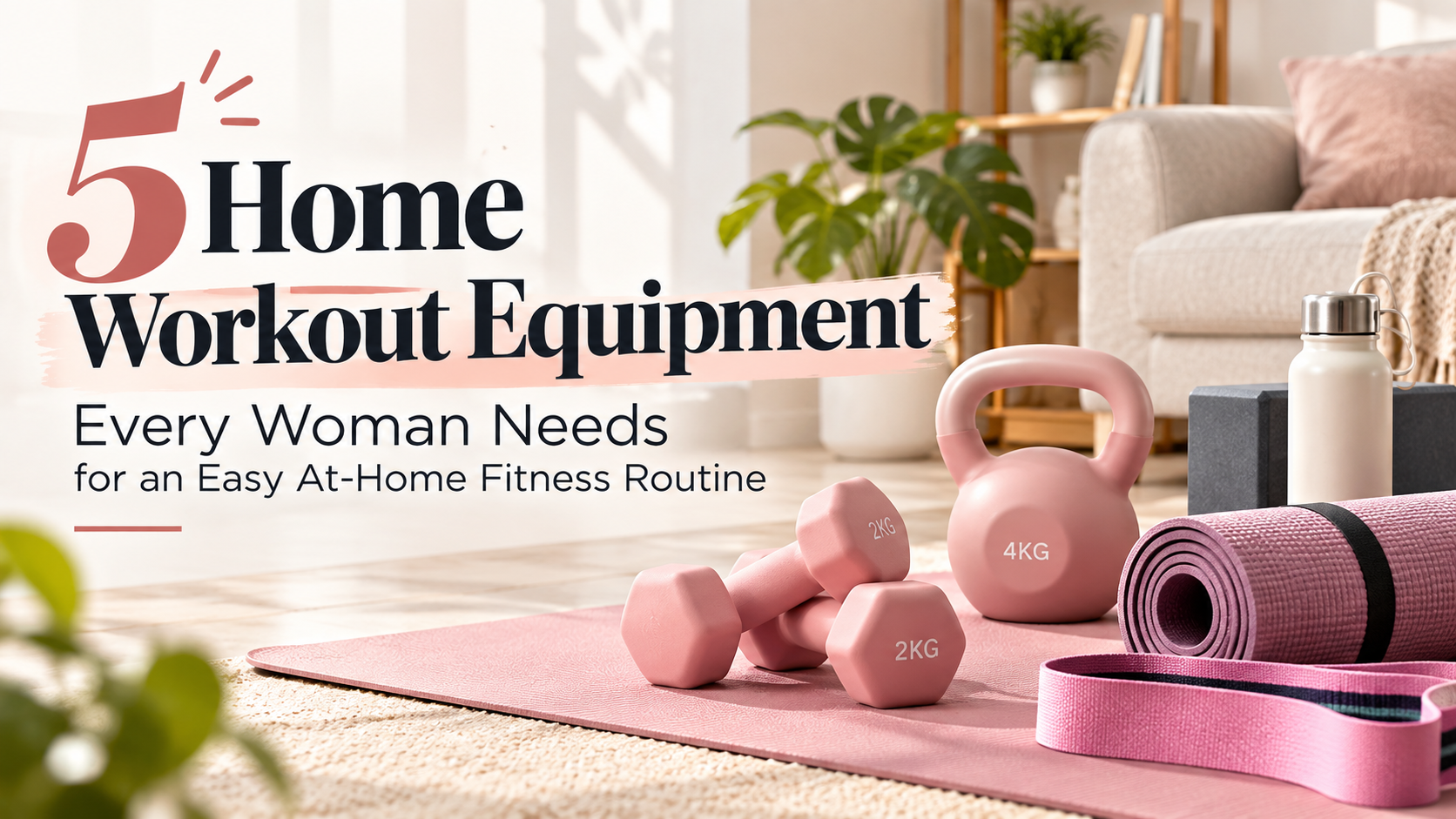

You don’t need a gym membership or a room full of expensive equipment to stay active.
With a few simple and versatile workout tools, you can create an effective exercise space right at home. Whether your goal is to get stronger, improve flexibility, support weight management, tone your body, or simply move more every day, the right equipment can make home workouts more enjoyable and easier to maintain.
The good news is that most home workout equipment is compact, affordable, and easy to store. You can use it in a bedroom, living room, balcony, or small home gym.
In this guide, we’ve selected 5 practical workout tools and accessories for women who want to exercise at home, from beginner-friendly resistance bands to adjustable dumbbells and supportive yoga mats.


1. Resistance Bands
Best for: Beginners, strength training and full-body workouts
If you’re building your first home workout setup, resistance bands are one of the most useful pieces of equipment to start with.


Unlike traditional weights, resistance bands are lightweight and easy to store. You can keep a set in a drawer or small storage box and take them with you when traveling.
Resistance bands come in different resistance levels, so you can gradually increase the challenge as you become stronger.
What can you do with resistance bands?
You can use them for exercises such as:
- Squats
- Glute bridges
- Lateral band walks
- Shoulder exercises
- Rows
- Chest presses
- Leg extensions
- Hip abductions
- Arm exercises
They are particularly useful for lower-body workouts because exercises such as banded squats, glute bridges and lateral walks can add resistance without requiring heavy weights.
Why women may like resistance bands
Compact: They take up very little space.
Affordable: A complete set usually costs much less than a set of traditional weights.
Versatile: You can use them for strength, mobility and activation exercises.
Beginner-friendly: You can start with light resistance and gradually progress.
What to look for
When buying resistance bands, look for:
- Several resistance levels
- Durable latex or fabric construction
- Comfortable handles if you prefer handled bands
- Secure attachment points
- A storage bag
- Clear exercise instructions
For a first home gym, a set with light, medium and heavy resistance is usually more versatile than buying a single band.
LamadHub tip: If you have limited space, resistance bands are one of the easiest ways to add strength training to your home routine.
2. Adjustable Dumbbells
Best for: Strength training and building muscle
If resistance bands are the lightweight option, adjustable dumbbells are the space-saving alternative to owning a complete rack of weights.


Traditional dumbbells are effective, but buying multiple pairs can quickly take up a lot of space.
Adjustable dumbbells solve this problem by allowing you to change the resistance using one compact set.
What exercises can you do?
A pair of adjustable dumbbells can be used for:
- Goblet squats
- Romanian deadlifts
- Lunges
- Shoulder presses
- Bent-over rows
- Biceps curls
- Triceps extensions
- Chest presses
- Lateral raises
This makes them useful for both upper-body and lower-body workouts.
Why choose adjustable dumbbells?
The biggest advantage is progressive resistance.
As your strength improves, you can increase the weight rather than buying an entirely new set of dumbbells.
They can also be particularly useful for women who want to move beyond bodyweight workouts and create a more structured strength-training routine.
What to look for
Before buying, check:
- Weight range
- Adjustment mechanism
- Grip comfort
- Overall dimensions
- Locking mechanism
- Warranty
- Storage design
Some adjustable dumbbells use plates and a locking mechanism, while newer designs allow the weight to be changed using a selector system.
LamadHub tip: If you’re serious about strength training but don’t have space for a home gym, adjustable dumbbells can give you many of the benefits of a larger weight collection in a much smaller footprint.
3. Exercise Mat
Best for: Yoga, Pilates, stretching and floor exercises
An exercise mat may look simple, but it can make a surprisingly big difference to your home workout experience.


A good mat provides a cleaner and more comfortable surface for floor exercises while giving you some cushioning between your body and a hard floor.
You can use it for:
- Yoga
- Pilates
- Stretching
- Planks
- Sit-ups
- Glute bridges
- Mobility exercises
- Bodyweight workouts
Why is an exercise mat useful?
A hard floor can be uncomfortable when you’re performing exercises that involve your knees, hips, elbows or spine.
A suitable mat can provide:
Cushioning: More comfort during floor exercises.
Grip: Helps reduce unwanted movement during certain exercises.
Personal workout space: Simply rolling out your mat can create a visual cue that it’s time to exercise.
Easy storage: Most mats can be rolled up and stored against a wall or inside a closet.
What should you look for?
Consider:
- Thickness
- Non-slip surface
- Material
- Length and width
- Ease of cleaning
- Weight
- Storage strap
If you mainly do yoga or Pilates, a thinner mat may be enough. If you perform more floor-based strength exercises, you may prefer a mat with additional cushioning.
LamadHub tip: Don’t automatically choose the thickest mat. A very soft surface can sometimes make balance exercises more difficult.
4. Mini Stepper
Best for: Cardio workouts in small spaces
If you want to add more movement to your day but don’t have room for a treadmill or exercise bike, a mini stepper can be an interesting option.


A mini stepper is a compact exercise machine that simulates a stepping motion. Some models also include resistance bands or handles to incorporate upper-body movement.
Because of its small footprint, it can be easier to store than larger cardio machines.
Why consider a mini stepper?
- Compact
- Easy to store
- Suitable for short workouts
- Can add cardio movement to your routine
- Some models include resistance bands
- Doesn’t require a large dedicated workout area
You can use it while listening to music, watching a show, or following a short home workout session.
However, don’t assume that a mini stepper is automatically suitable for everyone. If you have joint problems, balance difficulties, or another condition that affects exercise, choose activities appropriate for your situation and seek professional advice when needed.
What to look for
When comparing mini steppers, check:
- Maximum user weight
- Pedal size
- Stability
- Hydraulic or resistance system
- Noise level
- Step height
- Display functions
- Warranty
A sturdy base is particularly important. A compact machine isn’t useful if it feels unstable while you’re exercising.
LamadHub tip: A mini stepper can be a practical choice for small apartments where a treadmill or elliptical machine simply isn’t realistic.
5. Ankle and Wrist Weights
Best for: Adding light resistance to everyday workouts
Sometimes you don’t need a large piece of equipment at all.
Ankle and wrist weights are small accessories that can add extra resistance to selected movements.


Ankle weights can be incorporated into certain controlled lower-body exercises, while wrist weights can add resistance to some low-impact movements.
They are especially convenient because they are:
- Small
- Portable
- Easy to store
- Simple to use
- Suitable for light resistance exercises
Exercises you can try
Depending on the exercise and your fitness level, ankle weights can be used with movements such as:
- Leg raises
- Glute kickbacks
- Side leg lifts
- Standing leg exercises
Wrist weights may be used during certain controlled arm movements or low-impact walking routines.
Start light
This is important.
Adding weight doesn’t automatically make an exercise better. If the added resistance changes your technique or causes discomfort, remove the weights.
Start with a light load and focus on controlled movement and good form.
What to look for
Choose weights with:
- Secure fastening
- Comfortable material
- Adjustable weight if possible
- Even weight distribution
- Durable stitching
- Easy-to-clean surfaces
LamadHub tip: Ankle and wrist weights are best viewed as optional accessories rather than essential equipment. They’re useful when you already have a comfortable exercise routine and want to introduce a small amount of additional resistance.
How to Build a Simple Home Workout Setup
You don’t need to buy everything at once.
A simple setup can start with just three items:
Beginner setup
Exercise mat + resistance bands + light dumbbells
This combination allows you to perform a surprisingly wide variety of exercises.
Strength-focused setup
Exercise mat + adjustable dumbbells + resistance bands
This gives you more options for progressive resistance training.
Cardio-focused setup
Exercise mat + mini stepper + resistance bands
This combination allows you to mix cardio-style movement with resistance exercises.
Small-apartment setup
If space is your biggest concern, choose equipment that can easily fit into a drawer or closet:
Resistance bands + exercise mat + ankle weights
You can create a functional workout area without dedicating an entire room to exercise.
5 Home Workout Tools at a Glance
| Equipment | Best For | Space Needed | Beginner Friendly |
|---|---|---|---|
| Resistance Bands | Strength & mobility | Very little | ⭐⭐⭐⭐⭐ |
| Adjustable Dumbbells | Strength training | Low | ⭐⭐⭐⭐ |
| Exercise Mat | Yoga, Pilates & floor workouts | Low | ⭐⭐⭐⭐⭐ |
| Mini Stepper | Cardio & movement | Low | ⭐⭐⭐⭐ |
| Ankle/Wrist Weights | Light resistance | Very little | ⭐⭐⭐⭐ |
How to Choose the Right Equipment for Your Goals
The best equipment isn’t necessarily the most expensive. Start with what you actually want to achieve.
Want to become stronger?
Choose adjustable dumbbells and resistance bands.
Want to improve flexibility?
Start with an exercise mat and incorporate stretching or yoga into your routine.
Want more cardio at home?
Consider a mini stepper if you have limited space.
Want to add light resistance?
Try ankle or wrist weights, but start conservatively.
Have very little space?
Resistance bands, a foldable exercise mat and small weights are among the easiest options to store.
Tips for Staying Consistent With Home Workouts
Having equipment at home is convenient, but equipment alone won’t create results. Consistency matters more.
Here are a few simple ways to make home workouts easier to maintain:
1. Keep your equipment visible
If your resistance bands are buried at the back of a closet, you’re less likely to use them.
Keep your mat or bands somewhere easy to access.
2. Start with short workouts
You don’t need to exercise for an hour every day.
A short, manageable workout can be easier to maintain than an ambitious routine that you quickly abandon.
3. Create a regular schedule
Choose specific days and times for exercise.
For example:
Monday: Strength
Wednesday: Cardio
Friday: Full-body workout
Weekend: Stretching or light activity
4. Progress gradually
As your fitness improves, you can gradually increase resistance, repetitions, duration or exercise difficulty.
5. Choose activities you enjoy
The best home workout routine is one you actually want to repeat.
Final Thoughts
Creating a home workout space doesn’t have to be expensive or complicated.
With just a few versatile pieces of equipment, you can perform strength training, cardio, stretching and mobility exercises without leaving home.
If you’re starting from scratch, resistance bands and an exercise mat are two of the easiest pieces of equipment to begin with. Once you’re comfortable with your routine, you can add adjustable dumbbells, a mini stepper or light ankle and wrist weights depending on your goals.
The key is not to build the biggest home gym possible. Instead, choose equipment that fits your space, budget, fitness level and lifestyle.
A small workout corner that you actually use is far more valuable than an expensive home gym that sits untouched.
Simple equipment. Consistent movement. Better living.
That’s the kind of approach we believe fits naturally into the LamadHub philosophy.