
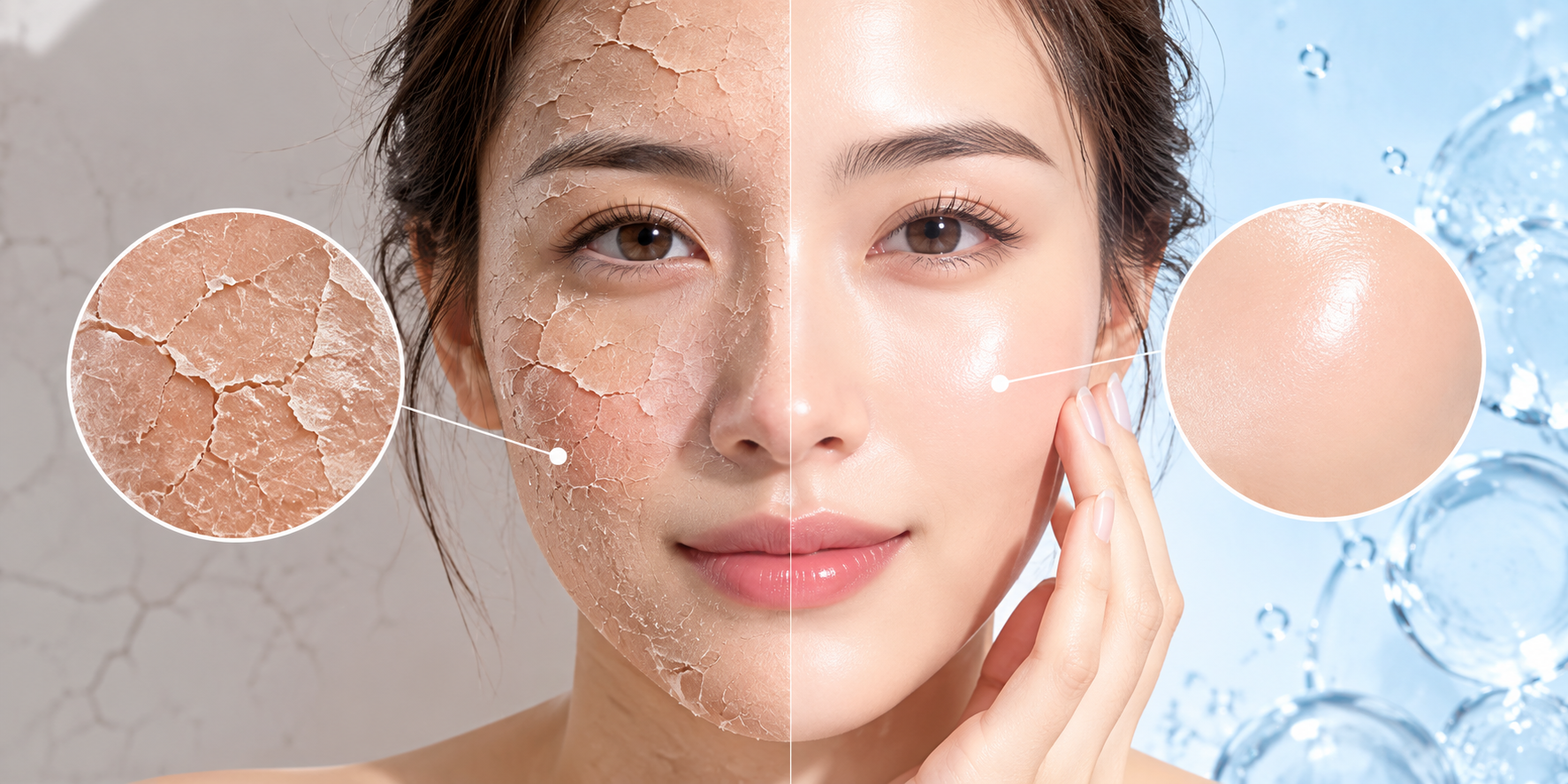

Dry skin can make your face feel tight, rough, flaky, or uncomfortable, especially after cleansing. The good news is that you don’t necessarily need a complicated skincare routine to improve the way dry skin looks and feels.
The key is to focus on three things: gentle cleansing, consistent hydration, and protecting the skin barrier. Ingredients such as ceramides, hyaluronic acid, glycerin, niacinamide, and petrolatum are commonly used in products designed for dry skin.
In this guide, we’ll look at how to build a simple dry-skin routine and introduce several products worth considering.
1. What Causes Dry Skin?
Dry skin occurs when the skin’s outer layer doesn’t retain enough moisture and lipids. This can leave the skin feeling tight and looking rough, flaky, or dull.
Several everyday factors can make dryness worse:
- Hot showers or washing the face with very hot water
- Harsh cleansers
- Over-exfoliating
- Products containing irritating fragrance or alcohol
- Cold or dry weather
- Low humidity
- Washing the skin too frequently
- Not moisturizing consistently
This is why treating dry skin isn’t simply about adding more serum. Protecting the skin barrier is just as important as adding hydration.
2. The Most Important Ingredients for Dry Skin
When shopping for skincare, don’t focus only on the product name. Look at the ingredients.
Hyaluronic Acid
Hyaluronic acid is a humectant that helps attract and retain water at the skin’s surface. It’s commonly used in hydrating serums and moisturizers.
Ceramides
Ceramides are important components of the skin barrier. Skincare products containing ceramides can help support the barrier and reduce moisture loss.
Glycerin
Glycerin is another moisturizing ingredient that helps attract water and improve the skin’s hydrated feel.
Niacinamide
Niacinamide can help support the skin barrier while also providing soothing and complexion-supporting benefits.
Petrolatum
For very dry skin, petrolatum can be particularly useful because it creates a protective layer that helps reduce moisture loss.
3. Step One: Use a Gentle Cleanser
If your skin feels tight immediately after washing your face, your cleanser may be too harsh.
For dry skin, look for a cleanser that removes dirt and makeup without leaving the skin feeling stripped. Fragrance-free and gentle formulas can be a good place to start.
Product to Consider: CeraVe Hydrating Facial Cleanser
CeraVe Hydrating Facial Cleanser is formulated for normal-to-dry skin and contains ingredients such as ceramides and hyaluronic acid.
It’s designed to cleanse without disrupting the skin’s natural moisture barrier.
Another option is CeraVe Hydrating Foaming Oil Cleanser, particularly if your skin is very dry. It combines squalane, hyaluronic acid, and ceramides in an oil-to-foam formula.
Tip
Use lukewarm water rather than very hot water. After cleansing, gently pat your face dry instead of rubbing it aggressively.
4. Step Two: Add a Hydrating Serum
A serum isn’t absolutely essential, but it can be useful if your skin feels dehydrated or looks dull.
A simple hydrating serum containing hyaluronic acid can add another layer of moisture before your moisturizer.
Product to Consider: CeraVe Hydrating Hyaluronic Acid Serum
This serum combines hyaluronic acid, vitamin B5, and three essential ceramides. CeraVe says the formula helps replenish hydration and support the skin barrier.
One useful tip is to apply a hydrating serum while the skin is still slightly damp, then follow with moisturizer to help seal in hydration.


5. Step Three: Don’t Skip Moisturizer
For dry skin, moisturizer is probably the most important product in your routine.
A good moisturizer doesn’t simply make your skin feel soft temporarily. It can help reduce moisture loss and support the skin’s protective barrier.
Product to Consider: CeraVe Moisturizing Cream
CeraVe Moisturizing Cream contains:
- Ceramides
- Hyaluronic acid
- Dimethicone
- Petrolatum
The richer cream texture makes it particularly suitable for normal-to-dry skin and areas that need additional moisture.
If you dislike thick creams, CeraVe also offers lighter lotion and gel textures.
How to apply it
Apply moisturizer while your skin is still slightly damp after cleansing or using your hydrating serum.
This simple step can help retain moisture more effectively.
6. Don’t Forget Sunscreen in the Morning
Dry skin still needs daily sun protection.
UV exposure can contribute to premature skin aging and can also make the skin feel more uncomfortable when the barrier is already compromised.
For a simple morning routine, you can choose a moisturizer that already contains sunscreen.
Product to Consider: CeraVe AM Facial Moisturizing Lotion SPF 30
This product combines moisturizing ingredients including ceramides and hyaluronic acid with broad-spectrum SPF 30.
If your sunscreen is separate from your moisturizer, that’s completely fine too.
The important thing is to make sunscreen a consistent morning step.
7. Nighttime Is the Best Time to Give Dry Skin Extra Care
Your nighttime routine doesn’t have to contain ten different products.
A simple routine can be:
Cleanser → Hydrating serum → Moisturizer
If your skin is particularly dry, you can add a thin layer of an occlusive product over your moisturizer on very dry areas.
Petrolatum-based products can help create a protective barrier and reduce moisture loss.
You don’t necessarily need to apply a thick layer all over your face. Focus on areas that become especially dry, such as the cheeks or around the mouth.
8. Exfoliate Carefully
Dry skin doesn’t mean you should scrub away every visible flake.
In fact, aggressive exfoliation can make dryness and irritation worse.
If you want to exfoliate, choose a gentle product and use it less frequently rather than exfoliating every day.
La Roche-Posay recommends minimizing potential triggers such as hot water, fragrance, and harsh exfoliants when dealing with dry skin.
If your skin is currently peeling, irritated, burning, or very sensitive, it may be better to simplify your routine and focus on hydration and barrier support first.
9. Three Products to Build a Simple Dry-Skin Routine
If you don’t want to buy a lot of products, you can start with just three essentials.
| Product | Purpose | When to Use |
|---|---|---|
| CeraVe Hydrating Facial Cleanser | Gentle cleansing | Morning & night |
| CeraVe Hydrating Hyaluronic Acid Serum | Extra hydration | Morning & night |
| CeraVe Moisturizing Cream | Moisture + barrier support | Morning & night |
Then add sunscreen in the morning.
If you prefer a lighter texture, CeraVe Hydrating Hyaluronic Acid Water Gel is another option. It contains ceramides, hyaluronic acid, and niacinamide in a lightweight gel formula.
10. A Simple Morning Routine
You don’t need a complicated 8-step routine.
Step 1
Gentle cleanser
Step 2
Hydrating serum
Step 3
Moisturizer
Step 4
Broad-spectrum sunscreen
If your sunscreen is already moisturizing enough, you may be able to simplify the routine by using fewer layers.
11. A Simple Night Routine
At night, focus on restoring moisture rather than adding lots of active ingredients.
Step 1
Remove makeup and sunscreen.
Step 2
Cleanse gently.
Step 3
Apply a hydrating serum.
Step 4
Apply a richer moisturizer.
Step 5
If necessary, apply a small amount of an occlusive product to particularly dry areas.
The goal is simple: cleanse without stripping, hydrate, then lock in moisture.
12. Everyday Habits That Can Help Dry Skin
Skincare products are only part of the equation.
A few small habits can make your routine more comfortable:
Avoid very hot water
Hot water can worsen dryness, especially when you spend a long time in the shower.
Don’t over-cleanse
If your skin feels tight after every wash, consider whether you’re cleansing too aggressively.
Use moisturizer consistently
Applying moisturizer only when your skin becomes extremely dry is less useful than maintaining a regular routine.
Consider a humidifier
A humidifier can be useful in particularly dry environments because it adds moisture to the air.
Be careful with fragrance
If your skin is sensitive as well as dry, fragrance-free products may be easier to tolerate.
13. What If Your Skin Is Extremely Dry?
If your skin is severely dry, cracked, painful, intensely itchy, or repeatedly irritated despite a gentle skincare routine, it may be more than ordinary cosmetic dryness.
In that situation, it’s better to consult a dermatologist rather than continuously adding new skincare products.
For ordinary dry skin, however, simplifying your routine can often be a good starting point.
Final Thoughts
Taking care of dry skin doesn’t have to mean buying a huge collection of skincare products.
The most important approach is to protect the skin barrier, add hydration, and reduce things that can strip moisture from the skin.
A simple routine could look like this:
Morning:
Cleanser → Hydrating serum → Moisturizer → Sunscreen
Evening:
Cleanser → Hydrating serum → Rich moisturizer
Products containing ceramides, hyaluronic acid, glycerin, niacinamide, and petrolatum are useful ingredients to look for when choosing products for dry skin.
If you keep the routine simple and use it consistently, your skin can gradually feel softer, more comfortable, and better hydrated without needing dozens of products.